PNF Stretching: The Contract-Relax Method Explained
What PNF stretching is, how the contract-relax method works step by step for hamstrings and hips, how often to use it and who should avoid it.
By Ayoub Farid · · 2 min read
PNF stands for proprioceptive neuromuscular facilitation, a long name for a simple idea: briefly contract a muscle, then stretch it further. Many people gain range faster with PNF than with static stretching alone, which is why it's popular for goals like the splits and touching your toes.
How it works (simply)
After a muscle contracts firmly, it often relaxes more easily, and your nervous system becomes more tolerant of the stretch. The result: you can sink a little deeper.
The contract-relax method, step by step
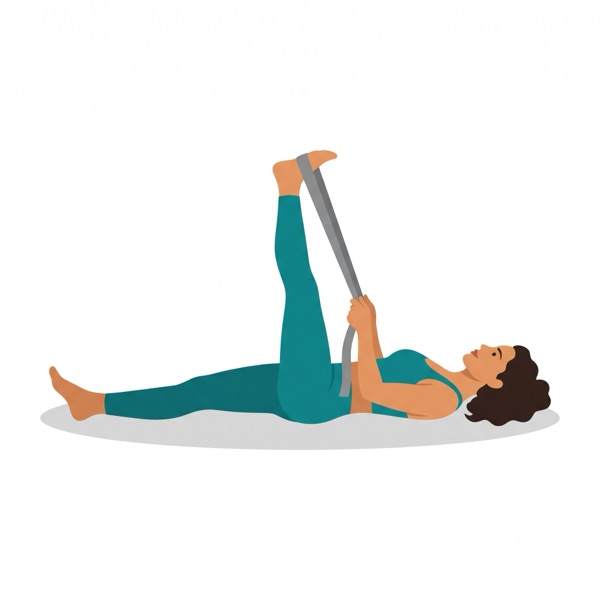
Example: lying hamstring stretch with a strap.
- Stretch: lie on your back, raise one straight leg with a strap until you feel a moderate stretch. Hold 10–20 seconds.
- Contract: without moving, push your heel down into the strap at about 30–50% effort for 5–6 seconds.
- Relax and breathe out.
- Stretch further: gently pull the leg a little higher. Hold 20–30 seconds.
- Repeat 2–3 rounds per side.
PNF for other muscles
| Muscle | Stretch | Contract by |
|---|---|---|
| Hip flexors | Kneeling lunge | Pressing back knee into the floor |
| Adductors | Butterfly | Pressing knees up into your hands |
| Glutes | Figure-4 | Pressing the crossed leg into your hands |
| Calves | Wall calf stretch | Pressing the ball of the foot into the floor |
| Chest | Doorway stretch | Pressing forearm into the frame |
How often
2–3 times a week for a given muscle group. It's more demanding than static stretching. Use gentle static stretching on other days.
Safety rules
- Moderate effort only: 30–50%, not maximum.
- No pain: strong stretch is fine; sharp pain isn't.
- Warm up first.
- Skip PNF on injured muscles unless your clinician recommends it.
- People with hypermobility should focus on strength rather than pushing range.
When to use it
- Working toward the splits or middle splits.
- A plateau in touching your toes.
- After workouts, when muscles are warm.
Not right before explosive sport; it's a flexibility session, not a warm-up.
Do it with Suppl
Suppl's routines use static holds with a timer. You can add PNF on your own: during a hamstring or hip stretch, do the contract-relax rounds before the timer moves on, or ask the AI stretch coach to talk you through a PNF session for a specific muscle.
Frequently asked questions
Is PNF better than static stretching?
It often produces faster short-term gains. Both work over time.
Do I need a partner for PNF?
No. A strap, wall or your own hands provide resistance.
How long should the contraction be?
About 5–6 seconds at moderate effort.
Can beginners do PNF?
Yes, gently, after a few weeks of regular static stretching.